


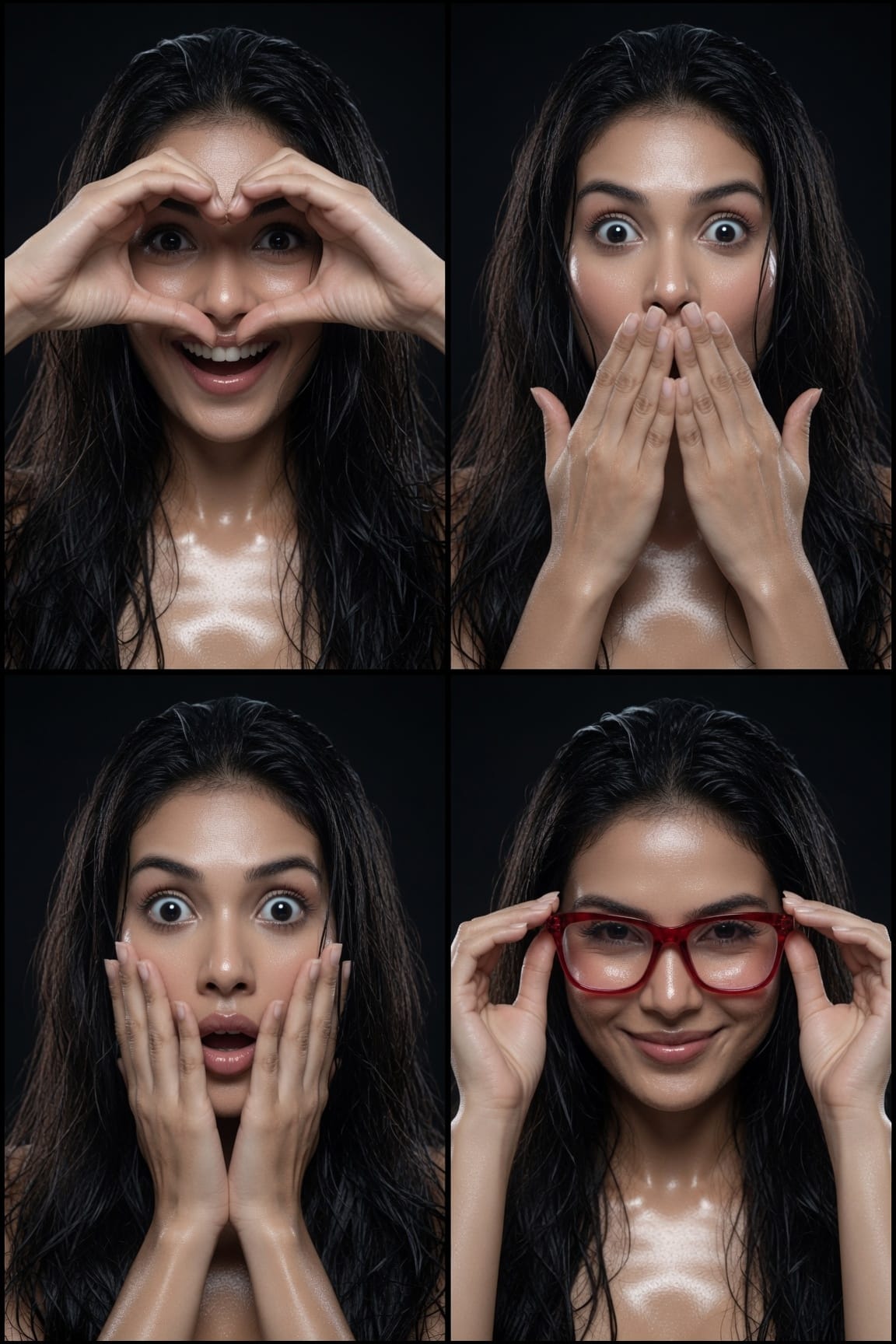
Every AI image generator can make a beautiful woman. That stopped being impressive about two years ago. Type a prompt into any of a hundred tools and you'll get a stunning result in twenty seconds.
Now try getting the same woman twice.
This is where almost every generator falls apart, and it's the difference between generating pictures and having a character. A gorgeous image of a stranger is a commodity. The fiftieth image of her, same face, same body, new scene, is something else entirely.
The stranger problem
Here's the experience everyone has with one-shot generators: you write a prompt, you get an image you love. You write the next prompt, and the woman in it is... close. Different jawline. Eyes slightly off. A stranger wearing your character's hairstyle.
The reason is structural. Most generators treat every prompt as a blank slate, the model rolls fresh dice each time, and "blonde, green eyes, athletic" describes about ten million different faces. Your words select a neighborhood, not a person. Copy-pasting the same prompt doesn't fix it; you're re-rolling, not remembering.
People invent workarounds, seed numbers, reference images, increasingly desperate prompt engineering with character sheets pasted into every request. The results are fragile, and the moment you change pose, outfit, or scene, the face drifts again.
Why consistency is the harder problem
Making one image beautiful is a solved problem. Making image fifty match image one is not, it requires the system to carry an identity across generations, not just a description:
- A persistent identity, not a prompt. The character has to exist as a defined entity the system references every time, so her face is retrieved, not re-invented.
- Consistency across engines. Different models have different strengths, one for realism, one for anime, one for video. If your character only exists inside one model, switching engines means losing her.
- Consistency across formats. The real test isn't the next image, it's motion. If her face survives into a five-second video clip, the identity layer is real.
This is exactly how Lovescape is built. Your character is defined once, the appearance you chose at creation, and every generation, on every engine in the lineup, renders that person. Pick a new model for a different style, move from image to video, change the scene entirely: same face, same body, same her. Every engine. One studio.
Why it matters more than quality
Because attachment doesn't come from beauty. It comes from recognition.
Think about what actually happens over weeks of using a companion platform. The conversations accumulate, she remembers things, the relationship builds continuity. If the images reset to a stranger every time, the visuals actively fight the story. The chat says "this is someone you know"; the pictures say "this is nobody in particular."
When the two line up, when the woman in today's image is unmistakably the one from three weeks of conversation, the whole thing clicks. Users describe this moment the same way they describe good memory: it stopped feeling like an app. Consistency is what makes generated images feel like photos of someone instead of output.
That's also why "quality vs. consistency" is a false choice pushed by tools that only have one of them. You need both. But if you could only have one, consistency wins, a slightly imperfect image of her beats a flawless image of a stranger every time. Nobody keeps a folder of strangers.
Getting the most out of it
Consistency is handled by the platform, but you can help it shine:
- Define the anchors at creation. Hair, eyes, build, the features that make her her, the system preserves what you defined. (Full walkthrough in our character creation guide.)
- Prompt the scene, not the person. Her identity is already locked. Spend your prompt on setting, outfit, mood, action, that's where the variety lives.
- Try her across engines. The same character rendered realistic, then anime, then in motion on LTX 2.3, recognizably her in each. That range is the feature.
- Let the library build. Fifty images of one character isn't repetition — it's the visual history of the relationship.
And the standing rule, one line: everything you generate lives inside the same hard limits as the rest of the platform, every character 18+, no real people, on every engine equally.
The bottom line
The question that matters when evaluating any AI image tool isn't "can it make something beautiful?" They all can. The question is: can it make her again?
If the answer is no, you have a slot machine that pays out in pretty strangers. If the answer is yes, you have a character, someone who's the same person in conversation, in images, and in motion. That's the difference between generating and having, and it's the entire reason Lovescape works the way it does.
You can start free.